
Since my return from Philadelphia I’ve been listening to Film Score Monthly’s groundbreaking release of the music of Superman. The FSM “Blue Box” contains eight compact discs containing the complete original scores from all four Christopher Reeve Superman films (1978-1987) and the music from the short-lived 1988 Superman cartoon series. It’s a remarkable achievement by such a small record label, who specialize in the music of the movies. The rich history of the Superman films and their music is documented in an accompanying 160 page book — a must-have for any fan of the series or the music of John Williams.
Superman: The Movie remains the quintessential superhero film and the comic book adaptation against which all others are judged. While director Richard Donner has had other successes — namely The Omen and the Lethal Weapon franchises — his most accomplished work remains Superman. The expensive and exhausting production of the original 1978 film has been documented elsewhere, most recently in the 12-DVD box set released by Warners in 2006 to celebrate their “year of Superman” that coincided with the release of Brian Singer’s Superman Returns. I’d like to focus on a few smaller aspects of Donner’s work, namely the music and the main titles.
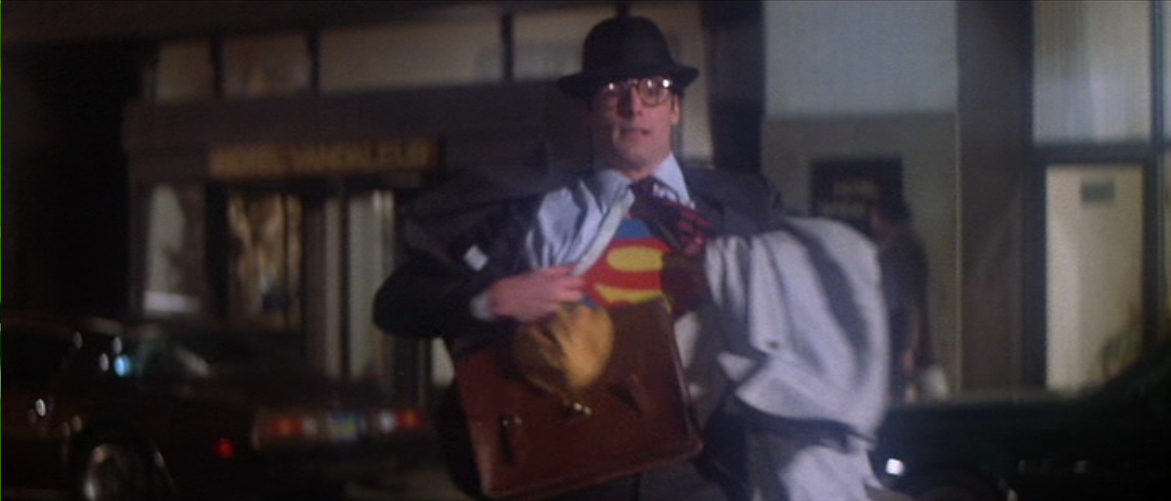
Listening to the music of Superman: The Movie by John Williams, I recall being six years old and hearing the soaring march for the first time. The Superman theme — which includes a brilliant three-note phrase that seems to call out “Sup-er-man!” — is the music of flight. It is visceral and transparent, and most important, it soars. Perhaps most interesting is the “balletic preparatory” music that precedes the introduction of the fanfare and, by corollary, Superman himself. It’s a dotted triplet rhythm that is carried by the low strings and sets a variety of action sequences in motion. It’s used to great effect during the first big reveal, when Clark Kent transforms into Superman on the streets of Metropolis to save the life of Lois Lane, who dangles off a building roof. There’s something about that “preparatory” phrase that is very John Williams. It’s dead serious, yet playful, and entirely cinematic. It reassures the audience of Superman’s imminent arrival in the same way that the shark motif in Jaws warned of imminent danger. The moment when Clark tears open his shirt, revealing the Superman shield, is effective because of this musical lead-up.
Part of the original film’s appeal is the opening title sequence — designed by R. Greenberg and Associates — that features the full musical fanfare and march in Dolby Stereo. Donner’s intent was to immerse the audience in the world of Metropolis and the mythology of Superman without losing a sense of verisimilitude — the quality of appearing real. This was also manifested in the film’s marketing campaign, which utilized the tagline “You’ll believe a man can fly.” As such, the film itself begins in a movie theater with the curtains closed. The frame-within-a-frame reveals another frame when the curtains part (like in those old picture palaces) and a screen appears, followed by the noise of an old projector.


The appearance of the date “June 1938” is followed by a black-and-white faux newsreel narrated by a small child, who explains that during the Great Depression, not even the great city of Metropolis was spared hardships and despair. The child turns the pages of an Action Comics book and the camera focuses on a sketch of the Daily Planet. The newsreel then dissolves to a live-action version of the Daily Planet building at night, and the camera arches beyond its roof and into the heavens.
Though music has been playing in the background up until this point, it’s been nondescript. A timpani roll formally introduces the beginning of the title sequence and the film-proper. The first title, that of producer Alexander Salkind, appears to move beyond the old-fashioned movie screen (whose ratio is approximately 1.33:1) and into the theater space. As the blue letters invade the theater space, the screen widens to the full Panavision width of 2.35:1 and the side curtains move beyond the limits of the frame.

The music continues to swell, building off of the preparatory phrase, until the S shield fills the screen with a red glow.


The remainder of the title sequence repeats the innovative 3-D effect for each name and credit, giving the impression they are flying past the audience.


The starfield background is occasionally interrupted by a cosmic anamoly or starburst, which is timed to the music. Or, should I say, the music is timed to the image. Either way, it works beautifully to convey the grand spectacle to follow. In his original review of the film, New York Times critic Bosley Crowther expressed his distaste for the sequence when he wrote that the “opening credits … are so portentous they could be announcing the discovery of a new mouthwash…”
Little did he know that the main title sequence was slowly fading from view. In the years since Superman: The Movie, studio executives and filmmakers have moved the bulk of credits to the end of the film. My own research reveals that by the early 1990s, most Hollywood films held the “main” credits for the end, reversing a long history of studio filmmaking that announced up-front who was responsible for the film you were about to see. Some have attributed this move to audience polling during advance screenings. Studios risk losing the audience’s attention during long, cumbersome title sequences. Even Steven Spielberg has noted that he prefers the end credit system, since it enables him to start the film without disruption or pause.
This is ironic since Spielberg’s Catch Me If You Can opens with one of the most entertaining title sequences in recent memory. Indeed, the animated titles pay homage to a by-gone era of studio filmmaking, when title songs and sequences became as famous — or even more famous — than the films themselves. Here I’m thinking of the Pink Panther and James Bond series, which incorporated complex animation and choreography to open each installment.


While Catch Me If You Can appears to be the exception, a number of studio films continue to place the main titles at the beginning of the film. They are noticeably translucent, tucked at the edges of the frame, in order not to detract from the introductory scenes that, no doubt, are establishing character and plot. The Devil Wears Prada opens with a montage sequence showing Andy and other women preparing for an early morning job interview. The sequence is set to the up-tempo KT Tunstall song “Suddenly I See,” which glues the whole thing together, and sets a rhythmic tone for the film to follow.
Some films have even crafted intricate and visually interesting end credit sequences. The second and third Bourne films showcase an array of graphics that interact with crew names. The use of Moby’s “Extreme Ways” works not only a musical signature for all three films (they all incorporate this song over the end credits), but it provides the quick tempo and catchy melody that turns ordinary credits into an arresting credit sequence. See the credits here.
Other films have dispensed with opening titles altogether. After studio logos, Michael Bay’s Pearl Harbor opens on the image of a sunset and gets down to business without even announcing the title of the film. Batman Begins opens with an elaborate sunset shot filled with swarming bats that form the shape of the bat signal. No title, just the shield. I admit there’s an immediacy to this technique, since you are instantly plunged into a fiction without the presentational aspects that have shaped our collective notions of movie structure.
More recently, 3:10 to Yuma, Michael Clayton, and No Country for Old Men offer their respective titles at the start of the film, but nothing more until the closing credits. This is by far the most common technique utilized by current filmmakers: state the title and get on with it.
For a while, especially in the 1960s, the title sequence was an emerging art form. Saul Bass is a legend in the field, producing the titles for Psycho, Anatomy of a Murder, Vertigo, It’s a Mad, Mad, Mad, Mad World, and my personal favorite, Casino. In addition to Superman, R. Greenberg and Associates created the titles for Home Alone and The Untochables. And, of course, Maurice Binder’s Bond sequences are among some of the finest and trashiest ever produced.

The novelty of these sequences lies in their ability to set a tone, create a visual and sonic signature, and synthesize the iconographic elements of a given film. The best ones can emerge as standalone set pieces, while others simply serve as introductory “warm ups.” It’s not surprising, then, that the Superman sequence began with a ritual that has also faded from our movie-going habit: the grand theater with a proscenium and curtains that reveal the screen.
Instead, we now get more commercials in front of the feature, smaller screens, and movies that are all too willing to cut to the chase.
What are your favorite title sequences?

 wright on film
Nice Site layout for your blog. I am looking forward to reading more from you.
Tom Humes
Casino Royale! You forgot to mention all of Tim Burton’s intro’s too…some good, some bad.
Well besides the Superman I really like the Once upon a Time in the West sequence with all the natural sound effects
Se7en.
superbad
Tim Burton’s Ed Wood, whose credits were by Robert Dawson. Dawson often works with Burton, on Edward Scissorhands, Mars Attacks!, Sleepy Hollow, Big Fish…He’s a pretty great modern title designer. More recently, the titles for Burton’s Sweeney Todd were great as well.
Empire Magazine, a British film magazine named a syndrome after Panic Room: great credits, bad film. I agree with the first part: The credits rock, the film wasn’t bad either.
I will never forget the opening title sequence of David Fincher’s Se7en. It totally set the tone for the movie and it was one of my formative introductions to “grown-up” movies as a young teenager.
Nice blog you have there. Check out http://www.submarinechannel.com/titlesequences/ for a compilation of great title sequences.
Supersonic Man, the best!
I’ve liked ALL of Pablo Ferro’s tltle sequences over the years, with Dr. Strangelove as a personal favorite. However, Cape Fear is great with the Bernard Herrmann score, especially that Deh-Duh-Duuuhhhhh. That Thing You Do! has a good title sequence as well.
Just to name a few, in no particular order: Casino Royale (1967), Se7en, Definitely Maybe, The Last Waltz, Once Upon a Time in the West, the Pink Panther Flicks, some of the Bond movies, The Thomas Crown Affair (1968), the Austin Powers movies, Yours Mine and Ours (1967), and–my all-time favorite–The Good, The Bad, and the Ugly.
One of my favourites is Rocky V. It’s an electrifying montage of the fight between Rocky and Ivan Drago from Rocky IV, expertly cut to Bill Conti’s ‘Conquest’ theme.
I still think the best opening title sequence of the 1990’s was “Blade.” It utilizes the rising immediacy of the music with a visual introduction of all the major characters, as the actual titles sneak by…
Other, graphical “opening” title sequences have been relegated to the end of the films, as with “Harry Potter,” or the Spider-Man sequels. Still elaborate, and could have just as easily appeared in the front of the film… but someone decided to relegate them, even though those movies were unlikely to chase people off in the opening minutes.
Spiderman 2. Loves the way it uses the titles to recap the first film. Fight Club also has a cool title sequence- the tracking shot of Jack’s brain that ends with the end of a gun, all set to the Dust Brothers track.
Most recently i think the opening sequence to Kiss Kiss Bang Bang (2005) was fantastic, a homage to early noir. But i am also fond of many of the above that have been named, aswell as the original Terminator sequence with that chilling Brad Fiedel score, theres just to many to name!
Personally I prefer a film that has the title at the start at the very least. Garbage like “Summer of Sam” showed me what appears to have been a starting trend, the film with no opening credits, only the title at the end. I hate that, it feels like I have been cheated. Indeed, there is nothing quite like spectacular opening sequences like that of “Superman”. Neat site all up
For whatever reason, still love the claymation title sequence to Brain Donors, with Mark Mothersbaugh’s amazing music.
One of my favorite is “12 Monkeys” http://youtube.com/watch?v=ifx9HxpfzIE&feature=related
“Dead Man on Campus” was surprisingly inspired in its opening titles, and “300” had amazing end-titles. It’s also worth noting that there are new expectations/demands of an opening title sequence. Despite the ADHD culture we live in, where everything is handheld, wi-fi and Bluetooth, films like the “Dawn of the Dead” remake AND “Seven” really do still harken back to “To Kill a Mockingbird”. Even the lack of opening titles mentioned in (shudder) “Pearl Harbor” have clear roots in films like (the original cut of) Orson Welles’ “Touch of Evil”.
I remember the title sequence to the film “Speed”, not for any reason other than it was remarkably dull. Felt like ten minutes of scanning down a building. But hey, at least I remembered it!
Has anyone seen the Opening titles to the Family Guy Movie?
They made it deliberately emphasised the title sequence… cant find it online though…
Dawn of the Dead (2004) has one of the best title sequences of recent times that I can think of, with the most effective of licensed music and quick-cut montages I can think of. Throws you right into the midst of it all.
Eternal Sunshine of the Spotless Mind is worth mentioning not just because it has a fairly memorable good title sequence, but more to do with it being placed twenty minutes in.
Going back to the 90s, Se7en is an obvious one, but I thought I’d mention T2. Which was a big event picture but still saw the need for a title sequence, which works wonderfully after the particularly chilling opening nuke scene and subsequent future war.
se7en,dawn of the dead (2004), hostage, catch me if you can, every david lynch film u can think of, fight club of course
The Kingdom had to have the best opening sequence in recent memory, even upstaging the film itself. It opens with a gripping, hard-hitting documentary-style look at the history of Saudi Arabia mixing real footage and animation, all set to a driving score by Elfman. The credits are intermingled into this opening.
Thank you! This article has needed to be written for some time! Well done.
The demise of the opening title sequence definitely reflects a social standard – urgency. But with urgency comes distance, a lack of connection. When, in recent memory, have you connected with a film on a deeply emotional level? For me it has only been in films with a slow warm up, stories that take time to get going, not ones that fire you out of a canon right from the opening frame.
Title sequences provide that slow warm up, in addition to providing a visual element to another technique long since forgotten in Hollywood – the overture. Another slow warm up technique used to draw the audience into the experience, the overture is still used to this day in the theater and just about every show currently playing on Broadway. It helps transition the audience from the real world and into the world of art, the world where they are about to spend a great deal of time, and hopefully emotion.
Title sequences, overtures, heartfelt gradual transitions into a story have proven to make for a much more satisfying, and connected, movie-going experience. There is something to be said about the values of the past.
Panic Room, in Fact David Fincher has always been good with opening title sequences…(see Se7en, Fight Club)
I wholeheartedly agree with you about the title sequences of “Superman” (which I saw as an 8 year old in a HUGE theatre…stunning!) and “Casino” which, sadly, I have never seen on the big screen, but surely attests to the genius of Saul Bass. (St. Matthew’s Passion is a brilliant audio to go with the images).
Nothinig surely compares to the opening credits of “Gone with the Wind.” Every time I see that title blowing across the screen, it never ceases to give me chills. Selznick shows off all the moxy he has in those extended opening credits; in an age where studios typically crammed as much information as they could into that frame, we are taken by the hand with so much confidence that we are in for one sweet ride back to the Old South.
One of my favourites is the title sequence Tomato did for “The Jackal” (1997). It’s not a great movie but the intro is brilliant. Music by Massive Attack. Chilling.
Many of my favorite title sequences have been listed above. But one of my favorites not mentioned is City Slickers. Very entertaining.
I don’t think title sequences will completely die. And I like the fact that some movies have them and some don’t. Believe me, there are some movies that you just don’t want to waste time with that!
The early portion of the title sequence of The Talented Mr. Ripley, Casino Royale (except for that terrible Chris Cornell song), Catch Me If You Can, and Christmas Vacation!
Superman the Movie, is one of my all time faves. And the credits and the music play a big part.
Really enjoyed ur article. Looking forward to more.
Like others, I liked Se7en’s title sequence a lot. (And the from-the-top end credits were a neat idea, too.) Also 2001 was pretty good.
I saw There Will Be Blood a couple of days ago (for the second time) and I really noticed the way it just had the title at the beginning and nothing else. I guess that’s the kind of simplicity this article is somewhat lamenting, but I thought it really worked. It was almost more a declaratory statement than a title. Like, don’t just think this is a movie about an oil man; before we’re done here, somebody’s going to die.
The opening sequence of the movie “Bullitt” was one of the most visually arresting (no pun intended) I’ve ever seen. Every time I watch the movie I’m fascinated by it. The minimal score, heavy on the percussion, creates an atmosphere of tension that carries the viewer right on into the film.
2001: A Space Odyssey
It seems more interesting things are being done with the End Credits now. 300, Shoot ‘Em Up, or Michael Clayton and just a few examples off the top of my head.
I’d agree with another comment – Bullitt is a classic title sequence. I’m surprised nobody mentioned “Psycho”, “Vertigo” or “North by Northwest”. A couple more classic title sequences are “The Knack … and How to Get It”, “A Hard Day’s Night” and “Help”.
Always with the fetty Cherles.
I absolutely loved the opening title sequence for LA Confidential. Curtis Hanson brought me right into the world of of 1950’s LA and Hollywood with music, pictures and Danny DeVito’s great voiceover about the seedier side of Hollywood life. From the sparkling beaches and orange groves to porn and prostitution, it’s all covered in a few delicious minutes. What a treat!
There are some good points and some bad points.
Nightwish are shit ahaaa lalpants snakes- Breadknife, pills.
Napoleon Dynamite, awesome!
Dawn of the Dead (2004), Panic Room, The Hills Have Eyes (2006), Seed of Chucky, and Juno come to mind as the best opening title sequences I’ve seen in a while.
My all time favorite credits are for Return of the Pink Panther, done by Richard Willams. The panther, in my opinion, had never looked better. I also like Saul Bass’ credit sequence for It’s a Mad, Mad, Mad, Mad, Mad World. Don’t tell you much about the movie that followed, except that there’s a lot of crazy stuff coming up.
Fight Club had awesome titles… come to think of it, many Fincher films do! Se7en (great), Panic Room had some interesting titles and Zodiac’s worked quite well, too.
One of the most innovative that I can think of was for Lord of War.For those who haven’t seen it, its done in quite a similar style to a classic Tim Burton title sequence and it charts the history of a single bullet all the way from its manufacture to it being fired into the head of a small child in a war-torn city.
shame that the actual film couldn’t live up to that opening.
I agree with most everyone who already posted. Another fave for me is the opening to “The Fugitive”. Not that the titles themselves were anything special, but I just LOVE the way they take their time to cover the whole opening. You get drawn into the story over about 15 or 20 minutes, then see another title flash on the screen and suddenly remember that this is all still just prologue to the main story, and you think, if I’m this drawn into the intro, this is gonna be a great movie. Once the titles end, you know you’re about to get down to the good stuff. Just brilliant.
Also the credits to “JFK” are amazing with their ability to create so much tension in so little time. All the editing that went into that sequence alone is phenomenal.
Some of my recent favourites have been end title sequences. What Pixar did with The Incredibles, is nothing short of mindboggling. That one had me floored. Probably my favourite of anything, ever, in the history of creation. Also incredibly beautifully designed: Lemony Snicket’s “A Series of Unfortunate Events”. Wonderful work.
Mark Forster seems to know what he likes, too. Both “Stranger Than Fiction” and – particularly – “The Kite Runner” have very special, beautiful opening credits. I always liked the simplicity of A Fish Called Wanda, credits in the aquarium, some fish in front, some behind the writing.
And I remember seeing the credits for (brace yourselves) “Howard the Duck” in the cinema as a kid, and they had this solid 3D title floating in earth orbit, with a simple pan down, but so vertigo-inducing, it stayed with me all my life. Dead as doornails on home video, though. I guess, you had to be there.
Serenity (2005) had one of the more interesting “blends” as far as openening sequences goes. Like Raiders of the Lost Ark and Hard Rain, it included the studio logo (in this case, Earth) as it’s opening image. Serenity beginning gives a background story with no music, and the movie title is seen on the same-named Firefly transport ship as the music cues up and the cast credits begin.
I don’t think this one has been mentioned yet. Many that I would put on the list have. But how about this:
Real Genius. I haven’t found a copy of the opening credits online, but I encourage others who care about opening sequences to check it out.